
“The Many Venices”: Walking as a Way of Reading Venice
At the heart of this year’s collaboration is The Many Venices, a programme of walks curated by TBA21–Academy / Ocean Space and Wetlands. Running from 5 June to 25 September across Venice, Mestre, and Murano, the project explores stories, communities, and perspectives often overlooked by dominant narratives, revealing the many layers that shape the city.
The project unfolds in dialogue with In Minor Keys, the 61st International Art Exhibition of La Biennale di Venezia, whose curatorial framework encourages new ways of listening to overlooked stories, perspectives, and forms of knowledge.
We spoke with Barbara Nardacchione, Community Engagement Lead at Ocean Space, and Luca Cosentino, co-founder and editorial director of Wetlands, about walking as a practice of discovery and a way of understanding the city.
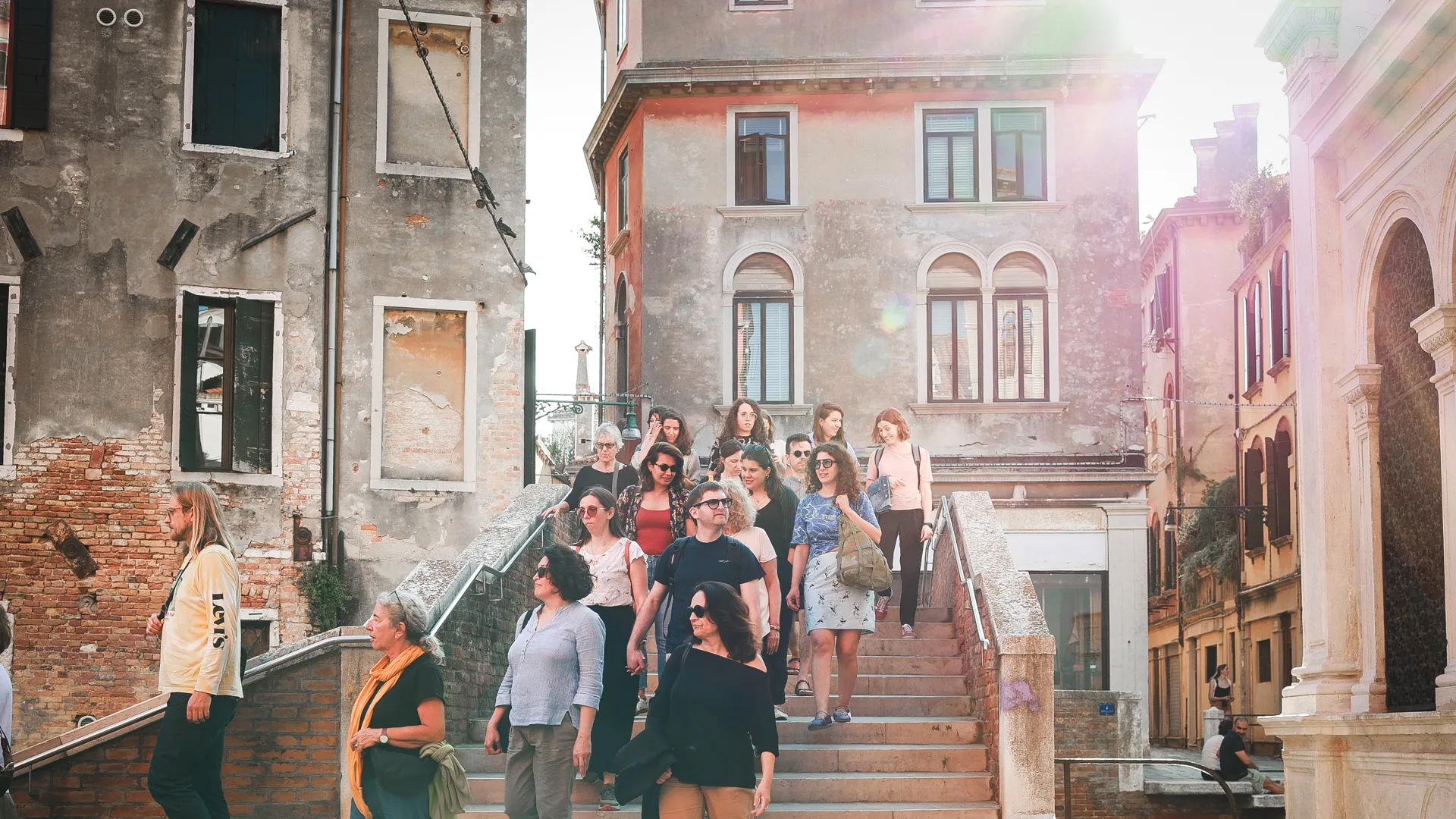
“The Many Venices” is already a statement in itself: there is no single Venice. How did this project come about, and why did you find yourselves working on it together?
Barbara Nardacchione: Ocean Space has a long history of walking programmes. They emerged almost out of necessity during the pandemic, when public space became the only possible place for gathering, and gradually evolved into a way for local communities and visitors alike to discover Venice and its islands through the expertise of the people guiding us.
Walking has allowed us to tell stories about the Venetian archipelago, the ecological challenges it faces, the urban and social fabric that defines it, and the narratives and counter-narratives embedded within the city. It is a way of understanding Venice in all its complexity, which is precisely where the title The Many Venices comes from: a desire to move beyond a singular vision of the city.
Our collaboration with Wetlands developed naturally. We have long shared a similar perspective on Venice and often engage with related themes, albeit through different formats. This year’s exhibition, Tide of Returns, is in dialogue with Wetlands’ Afterwords series, dedicated to some of the most innovative voices from Africa and the African diaspora. It felt like the perfect opportunity to create a co-curated programme of walks.
Luca Cosentino: Wetlands was founded out of the need to tell stories about Venice in unconventional ways. Our editorial work has always been deeply rooted in place. The books we publish often emerge from situated practices, overlooked histories, and cultural exchanges that mainstream narratives about Venice tend to ignore.
African Venice / Venezia africana, which we published in 2024, is perhaps the clearest example. It is a guidebook that explores Venice through its historical and contemporary connections with the African continent – from migration routes and the communities that live in the lagoon today, to African influences in Venetian art and architecture. Many of the threads woven through that book now find their way onto the streets through The Many Venices.
TheManyVenicesisnotsimplyanevocativetitle.Veniceismadeupofmanyplaces,anditisthispluralitythatcreatesitscomplexity–fromthemainlandtotheislands.Barbara Nardacchione
This year’s Biennale is titled In Minor Keys – a musical metaphor inviting us to pay attention to marginal voices and overlooked perspectives. How does The Many Venices connect with this theme?
Luca Cosentino: There is a deep resonance, and it is no coincidence. Minor keys are the frequencies that official narratives often leave out of the frame – peripheral neighbourhoods, minority communities, stories that never make it into tourist guidebooks. Our editorial work begins precisely there.
Walking is a way of tuning into these frequencies. You cannot ignore the sound of the water, the faces of people passing by, or the workshop that has been open for thirty years beside a souvenir shop. Everything becomes material. It is a way of experiencing the city that cannot be replicated in a guidebook or a caption.
Barbara Nardacchione: There is also a methodological connection. The Biennale is an extraordinary moment that brings artists to Venice carrying stories and perspectives from elsewhere. The Many Venices engages with those same minor keys through the city’s social fabric and through stories revealed by architectural and artistic elements that are often present but rarely considered through a colonial lens.
Each walk is led by someone whose work is deeply rooted in this city – from Italian-Rwandan writer and activist Marilena Delli Umuhoza, who will open a conversation around interracial perspectives, to Senegalese artist and master glassmaker Moulaye Niang, whose practice in Murano intertwines the glassmaking traditions of his homeland with those of Venice.
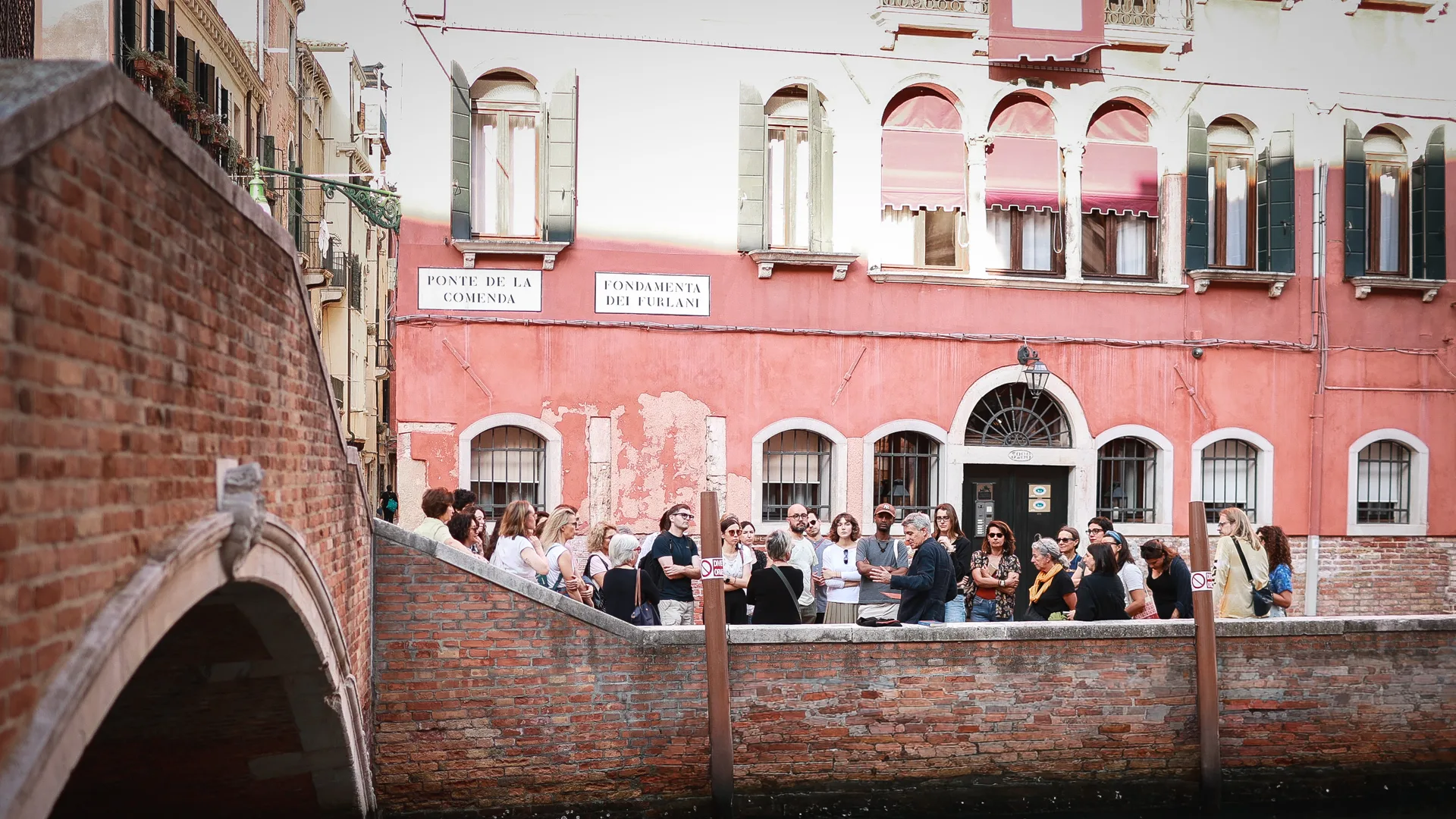
You have chosen to include not only the historic centre, but also Mestre and Murano. That feels like a deliberate choice – almost a statement.
Barbara Nardacchione: It is an act of geographical honesty. The Many Venices is not simply an evocative title. Venice is made up of many places, and it is this plurality that creates its complexity – from the mainland to the islands.
Most of the city’s population lives in Mestre, where many new stories of migration and urban transformation are unfolding. Through this programme, we wanted to bring those stories into focus. During her walk, Megnaa Mehtta will guide participants through the places, businesses, and everyday spaces that shape Mestre’s Bangladeshi communities, one of the largest diasporas in Italy.
Luca Cosentino: Murano, on the other hand, is much more than the island of glass that tourists know. Moulaye Niang’s walk will retrace the places that marked his first steps as a glassmaker, reflecting on the dialogue between different traditions that he has woven together in his atelier.
It is a story about Venice seen from within one of its most iconic industries – but through eyes that come from elsewhere, and which therefore notice things that those who grew up here may no longer see.
Forme,itisthefeelingofbelonging,evenifonlytemporarily,toacommunity.Walkingtogethermeanssharingsomething–adirection,acuriosity.Luca Cosentino
What do you hope participants will take away from these walks?
Barbara Nardacchione: Not necessarily answers – perhaps new questions. Even simply pausing on a bridge, in a street, or in a square that they may have crossed countless times without truly seeing it. Or hearing a story about a place they thought they already knew. These moments reveal Venice’s complexity and open it up to multiple interpretations.
Luca Cosentino: For me, it is the feeling of belonging, even if only temporarily, to a community. Walking together means sharing something – a direction, a curiosity.
At a time when cities are increasingly experienced in individual and mediated ways, gathering physically in a place with other people and looking at it together is already a rare gesture.And a necessary one.
The Many Venices runs from 5 June to 25 September 2026. The programme includes four walks: on 5 June with Luca Cosentino through Castello and Cannaregio; on 19 June with Megnaa Mehtta in Mestre; on 19 September with Marilena Delli Umuhoza in Venice’s historic centre (also suitable for children); and on 25 September with Moulaye Niang in Murano.
For more information, visit oceanspace.org.
Photo credit: The Many Venices. Camminata con Luca Cosentino”, Ocean Space, Venezia, 2026. Foto: Reyna Agostinelli.